How should a ring fit?
A ring fits well when it needs a little push to get over your knuckle, sits snug at the base of the finger, and can turn a bit without spinning all the way around. It should come off with a gentle twist, not a fight. GIA puts it this way: snug on the finger, but not so tight it causes discomfort. The gap between a good fit and a bad one is often half a US size, about 1.3 mm around the finger.
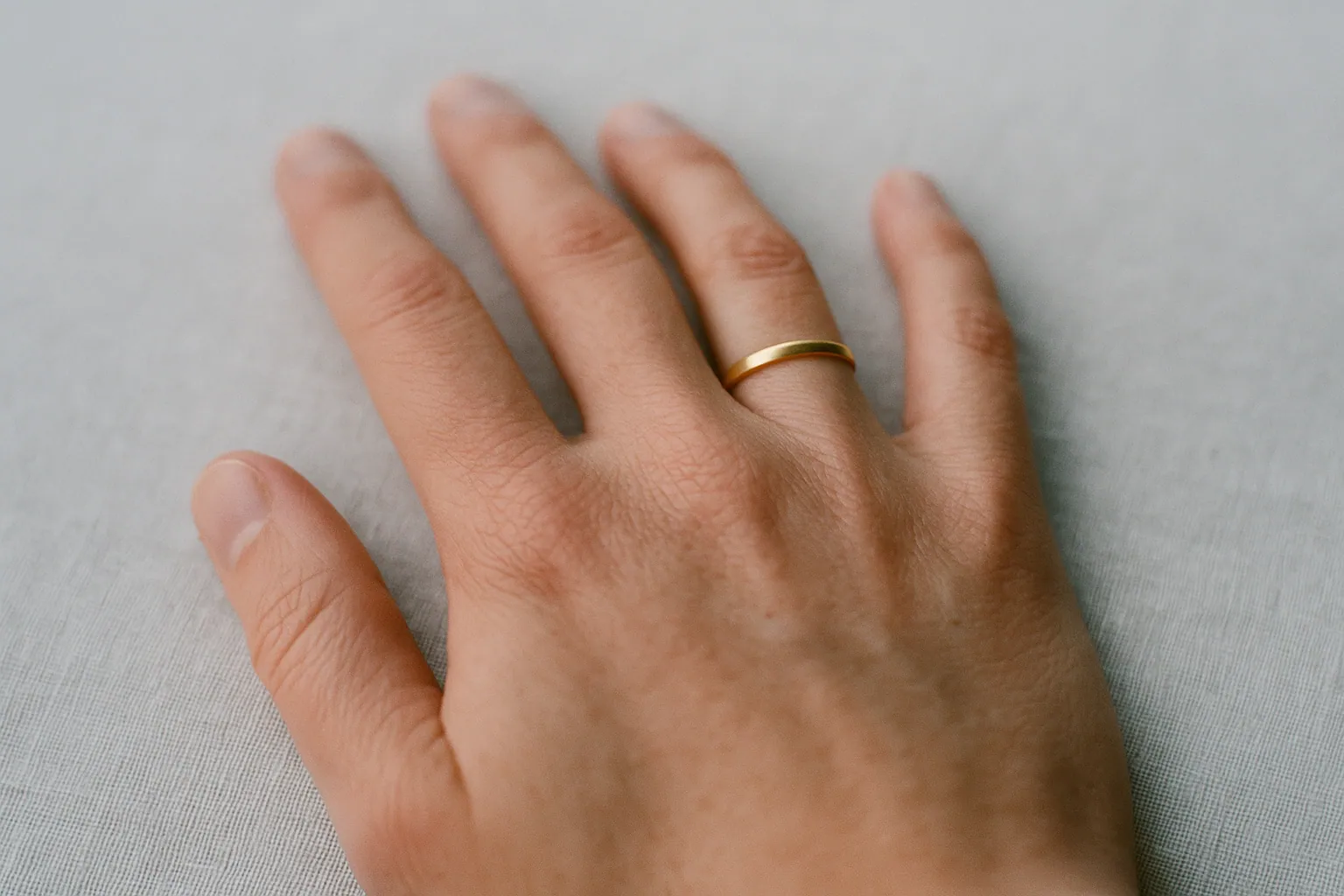
Most people check fit by feel, and feel is a bad judge. A ring that seems fine in a cool shop can pinch by dinner, and one that feels secure at your desk can slide off in a cold lake. The good news is that a proper fit has a few plain signs you can test at home in about two minutes, with the ring on your hand and no tools.
How tight should a ring be?
Tight enough that it needs a small push to pass the knuckle, loose enough that it doesn't leave a deep dent or change the color of your finger. Once it's on, you should be able to turn it a little with your other hand. It should not flop around on its own, and it should not feel like a band clamped around the base.
That window is narrow. On the US scale, each half size adds about 1.3 mm to the inside circumference of the ring and about 0.4 mm to its diameter. Split that across both sides of the finger and a half size is 0.2 mm of room per side, roughly the thickness of two sheets of printer paper. You can feel that difference. You can't see it, which is why the checks below go by feel and behavior instead of by eye.
Six checks for a good ring fit
Do these in the late afternoon, when your hands are warm and at the top of their daily range. A fit that passes then will pass most of the time.
- The knuckle push. Slide the ring on. It should stop at the knuckle for a moment and then go over with light pressure. If it slides straight past with no resistance, it can come off the same way.
- The twist off. Take it off again. A good fit comes off with a slight twist as it crosses the knuckle. If you need soap, lotion, or a second attempt, it's too small.
- The spin test. With the ring on, let your hand hang and shake it a few times. The ring can shift a little. If the stone or the top of the band ends up facing your palm, it's too big or too top-heavy.
- The fist test. Make a fist. A ring that's too tight will dig into the fingers on either side. Then open your hand flat: a ring that's too loose will slide toward the knuckle.
- The ten-minute mark. Take the ring off after wearing it a while. A faint line is normal. A deep groove, a white or red band of skin, or a dent that's still there after a few minutes means it's too tight.
- The cold rinse. Run your hand under cold water, then try the spin test again. Fingers shrink in the cold, so this is where a slightly loose ring shows itself.
If a ring passes four or more of these and the two that failed are close calls, you have a good fit. If it fails the knuckle push or the twist off by a wide margin, no trick will fix it and the ring needs a different size.
Signs a ring is too tight
The body tells you before the ring does. Watch for any of these:
- The skin puffs up on either side of the band.
- The finger feels warm, throbs, or tingles after a while.
- You see a white or red ring of skin when you take it off, and it doesn't fade quickly.
- The ring won't come back over the knuckle at the end of the day.
A snug ring on a swelling finger is more than uncomfortable. The Merck Manual, a reference used by doctors, advises taking a ring off before the finger swells enough to cause pain or cut off blood flow, because a trapped ring can press on the nerves and vessels underneath it. If you hurt your hand, get a burn, or get stung near the ring, take it off right away, before the swelling starts.
If a ring gets stuck, raise the hand above your heart for a few minutes and try again with soap or dish liquid. Don't yank it, which only swells the finger more. If the finger turns pale, blue, or numb, go to urgent care. Emergency staff keep ring cutters for this, and a jeweler can repair a cut band afterward.
Signs a ring is too loose
A loose ring rarely hurts. It gets lost. Look for these signs:
- The ring spins so the stone or pattern ends up under your palm.
- It slides toward the knuckle when your hand hangs down.
- You catch it on pockets, gloves, or a car seat belt because it shifts.
- It slips off when you wash your hands in cold water or take off a glove.
Cold is the danger here. A ring that stays put indoors in summer can slide off on a ski slope or into the sea, and you won't feel it go. Why ring size changes has the numbers on how far a finger shrinks and swells through the day and the year.
Why does my ring keep spinning?
There are two usual reasons: the ring is a little big, or it's top-heavy. An engagement ring with a large stone and a thin band carries most of its weight on top, and gravity pulls that weight around to the underside of your finger. That can happen even on a ring that is the right size.
The fix depends on the cause. If the ring is too big by more than a size, have it resized. If it's close to the right size or top-heavy, a jeweler can add something inside the band instead of cutting it:
- Sizing beads. Two small metal balls soldered inside the bottom of the band. TeachJewelry puts the usual reduction at a quarter to a half size and the cost at about $35 to $200. GIA notes they are a good choice for people with larger knuckles.
- A spring insert or sizing bar. A U-shaped piece of metal that flexes open to pass the knuckle and then presses back against the finger. It takes up more room than beads, so it suits a ring that is a size or more too big.
- A ring guard. A clip or plastic sleeve you slide on at home. It's cheap and removable, which makes it a good stopgap while you decide on a jeweler.
Beads can't be added to tungsten, titanium, or ceramic, because solder won't hold on those materials. Which rings cannot be resized covers the other limits.
What if my knuckle is bigger than my finger?
Size to clear the knuckle, then fix the looseness at the base. A ring sized to the base of the finger won't go on if the knuckle is a size bigger, and forcing it over every day is how people end up with a stuck ring. GIA's own advice is to size the ring so it slips over the joint, since the joint is the widest part.
Measure both spots. If your knuckle reads a US 8 and the base reads a 7, Blue Nile's advice is to pick a size between them. A 7.5 should pass the knuckle with a firm push. If the two readings are more than a size apart, the compromise ring will spin at the base, and that's where beads or a spring insert earn their place.
For big gaps, often from arthritis, there's a better option than a compromise. A hinged shank replaces the bottom half of the ring with a section that opens, so the ring goes around the base of the finger instead of over the knuckle and then locks shut. Brands include CLIQ and Superfit. It's the most expensive of the fixes, and for someone whose knuckle is two or three sizes larger than the base, it's the one that works.
Does band width change how a ring should fit?
Yes. A wide band feels tighter than a thin one at the same size, because it presses on more of the finger and has to squeeze over the knuckle across a longer stretch. GIA flags bands wider than 4 or 5 mm as needing special consideration. The rule we use across this site is about a quarter size up for a 4 to 6 mm band and a half size up for 6 to 8 mm.
Comfort fit bands go the other way. They are domed on the inside, so they slide over the knuckle more easily and often fit a half size looser than a flat band of the same number. The men's ring size chart has the width table and explains how the two adjustments cancel out on a wide comfort fit band.
Should a ring fit the same on both hands?
No. GIA says the ring finger on your dominant hand is about half a size larger than the same finger on the other hand. So if you're right-handed, a ring that fits well on your right hand will be loose on your left, and a ring sized for your left may not pass the knuckle on your right.
The same goes for moving a ring to a new finger. Your middle finger is often larger than your ring finger, and the index and pinky vary from person to person. Test fit on the finger where the ring will live, not the one where it happens to fit.
When is the best time to check fit?
In the late afternoon, at a normal room temperature, and not right after a workout, a hot shower, or a salty meal. Fingers are smallest in the morning and in the cold, and largest when you're warm. A ring that fits at 5 pm will fit most of the day. One that fits at 7 am may not.
Some changes aren't daily. Pregnancy often makes hands swell, especially late on, and many people move their rings to a chain for a few months. Sudden swelling of the face or hands is different: ACOG lists it as a possible sign of preeclampsia, so call your doctor if it comes on quickly. Weight change, a new medication, or arthritis can also shift your size over months, so recheck a ring that starts to feel different.
Check your size before you buy
If you're buying a new ring, get the number right before you worry about the feel. Our printable ring sizer prints a strip to true scale, with a card outline to confirm the page didn't shrink, and the converter on that page turns a millimeter reading into a US size. Measure the base of the finger and the knuckle, then check both numbers against the ring size chart. If your ring is already on your hand and one of the checks above failed, how to find your ring size walks through measuring a ring you own so a jeweler can size it to the right number.
Finden Sie Ihre Groesse in zwei Minuten
Drucken Sie einen massstabsgetreuen Ringmesser mit eingebauter Massstabskontrolle, oder rechnen Sie ein Mass in Millimetern direkt auf der Seite um.