How are rings resized?
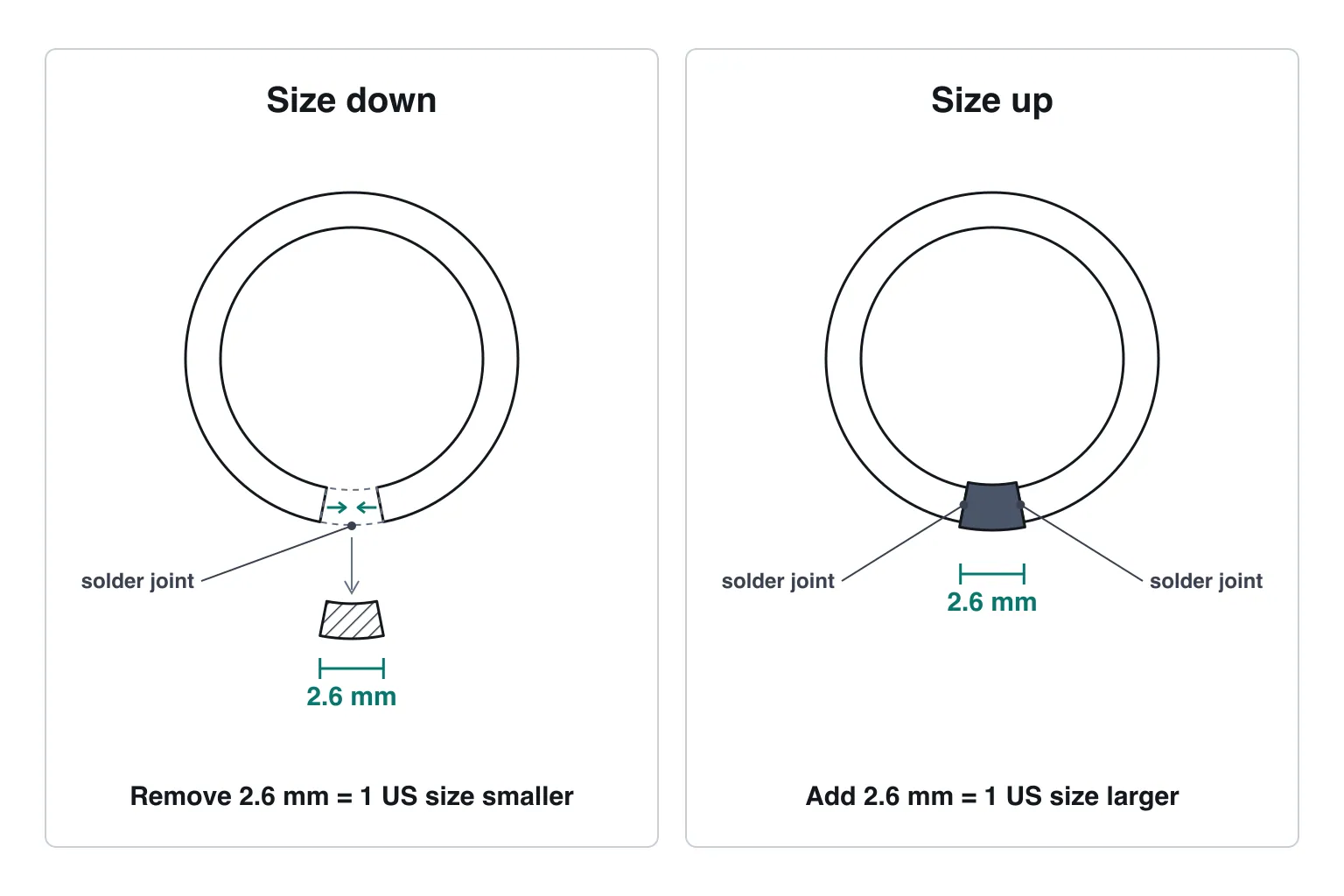
A jeweler resizes a ring by cutting through the bottom of the band, taking out or adding a short piece of matching metal, then soldering or laser-welding the joint and polishing it smooth. One full US size is about 2.6 mm of band: Stuller, a major supplier to US jewelers, gives its bench jewelers 2.61 mm per size. Small changes on a plain band can be stretched or pressed instead of cut.
A ring that pinches or spins goes to the jeweler and comes back fitting. In between, someone saws through the band, changes its length by a few millimeters, and closes it up again. Once you know how that works, you'll know what to ask before you hand the ring over, and when a cheaper fix will do the job.
How does a jeweler make a ring smaller?
To make a ring smaller, a jeweler cuts through the bottom of the band, removes a short piece of metal, and brings the two ends together. The joint is soldered or laser-welded, then the ring is tapped round on a steel mandrel, filed flush, and polished. Taking a size 7 down to a 6 removes about 2.6 mm of band.
The cut goes at the bottom of the shank, the plain part of the band that sits against your palm, as far from the stones as the design allows. Stuller's training article describes two ways to make the joint. A butt joint sets the two flat ends face to face. A dovetail cuts a V into one end so the other end locks into it. Stuller says the dovetail is the stronger of the two, but it's harder to fit, so it's used less often.
Pressing a band smaller without a cut
Some plain bands can shrink with no saw at all. The jeweler softens the metal with heat, then presses the ring into a tapered steel die. This is called swaging. Stuller limits it to plain half-round bands of even width that have never been cut and sized before, and to changes of two sizes or less. Flat bands and patterned bands come out distorted.
Swaging also rolls the edges of the band inward. So the jeweler presses it half a size past the target, then stretches it back on a mandrel to take the cup out of the edges.
How does a jeweler make a ring bigger?
To make a ring bigger, the jeweler cuts the band at the bottom and solders in a new piece of metal that matches the ring's karat and color. Stuller calls for a plug a little thicker than the band, so it can be hammered and filed down to match. That's two joints plus new metal, which is why sizing up costs more.
Going from a 7 to an 8.5 takes a plug about 3.9 mm long. On a 14k yellow band, the plug should be 14k yellow. On white gold, it should be white gold of the same karat. Ask what metal the jeweler plans to use, because a mismatched alloy can show as a faint line once the ring is polished.
Stretching a band
For a small jump on a plain band, a jeweler can stretch the ring instead of cutting it. The ring goes on a stretcher, a steel cone split into segments that push outward, and the band is worked a little longer. Jewelers on the Ganoksin forum, the trade's long-running discussion board, put the safe amount at about half a size at a time, with the metal softened by heat between rounds.
Stretching suits a band with no old joint. A ring that's been cut and soldered before can split open at the seam. Hard metals like titanium and stainless steel won't stretch at all.
How much metal is one ring size?
One full US ring size is about 2.6 mm of band. Stuller's figure is 2.61 mm added or removed per size, and the size chart steps 2.55 mm of inside circumference per size, so the two agree within a tenth of a millimeter. A half size is about 1.3 mm, close to one dime's thickness.
| Size change | Metal | For scale |
|---|---|---|
| 1/4 size | 0.65 mm | a bit thinner than a bank card |
| 1/2 size | 1.3 mm | one dime |
| 1 size | 2.6 mm | two dimes stacked |
| 1 1/2 sizes | 3.9 mm | three dimes |
| 2 sizes | 5.2 mm | four dimes |
The metal column uses Stuller's 2.61 mm per size. A dime is 1.35 mm thick, per the US Mint, and a bank card is 0.76 mm under ISO/IEC 7810.
Those numbers are why quarter sizes are normal at the bench. A jeweler can take out 0.65 mm as easily as 2.6 mm. If your measurement lands between two half sizes, ask for the quarter size instead of rounding.
Most jewelers stop at about two sizes either way, since bigger jumps can leave the band weak or loosen the stones. Which rings cannot be resized covers that limit and the metals that can't be sized at all.
Does resizing damage a ring?
Done well, resizing doesn't noticeably weaken a gold, silver, or platinum ring, and the joint is hard to find afterward. The risks sit around the cut: stones that don't like heat, plating that burns off, engraving in the path of the saw, and settings that shift. A good jeweler checks each one before quoting.
Stones and heat
A torch heats the lower half of a ring, and some gems can't take it. GIA's care guide for tanzanite warns against high heat and sudden temperature changes. A 1987 article in GIA's journal, Gems & Gemology, named emerald and tanzanite as stones that can be damaged by soldering close to where they're set. Opals hold water and pearls are organic, so jewelers keep both away from the flame too.
For rings like these, the jeweler either takes the stone out first or uses a laser welder, which melts a pinpoint spot and leaves the rest of the ring cool. BriteCo, a jewelry insurer, puts the added charge for reshaping or repositioning stones at $20 to $50 per stone.
White gold and platinum
Most white gold is plated with rhodium, a bright white metal, and the heat and polishing of a resize wear through it at the join. Jewelers re-plate the whole ring so there's no line where old plating meets new. Some include that in the quote and some charge it separately, so ask.
Platinum melts at about 1,768 C, against 1,064 C for pure gold. It needs a hotter torch, a high-temperature platinum solder, or a laser welder. BriteCo lists platinum as one of the pricier metals to resize and yellow gold as one of the easiest and cheapest.
Engraving, stamps, and settings
The inside of the band often carries a metal stamp like 14K or PT950, and sometimes an inscription. If either sits at the bottom of the shank, the saw can go through it, and a longer or shorter band moves an inscription off center. Tell the jeweler about anything engraved before work starts.
On a ring with a raised head, a big size change can bend the shank enough to tilt the center stone or open a prong. Ask for a prong check when you pick it up.
How much does it cost to resize a ring?
Expect $50 to $150 to make a ring smaller and $80 to $250 to make it bigger, per BriteCo's cost guide (updated November 2024). Platinum, white gold that needs re-plating, and stones near the cut push the price toward the top of the range. A plain yellow gold band sits at the bottom.
Check before you pay, because many rings from the big jewelers come with a free resize. Blue Nile includes one free resize in the first year, up or down two sizes, if the design allows it, and leaves out eternity bands. Brilliant Earth resizes free within 60 days of purchase, or within a year if the new size stays inside the ring's listed range. Tiffany resizes its engagement rings for free. Pandora goes the other way. It doesn't resize its rings at all, though a store will swap an unworn ring for a new size within 30 days.
Turnaround depends on where the work happens. A shop with a jeweler on site can often finish a plain gold band in a few days, sometimes the same day. Stores that ship rings out to a central workshop take longer. If there's a wedding or a trip coming up, ask for a ready date in writing.
How can you tell if a ring has been resized?
Look at the bottom of the band, inside and out, under a bright light. A resized ring often shows a faint line across the shank, a slight color change at the solder, a pit or two, or a thinner, flatter spot. A stamp cut in half is another giveaway. A careful job can leave nothing to see, especially under fresh rhodium on white gold.
Jewelers have a couple of tricks for finding a hidden seam. Posters on the Ganoksin forum describe dabbing on iodine, which turns some solders darker than the gold around them, or warming the ring for a moment so the joint shows. Neither works every time.
This matters most when you buy a secondhand or vintage ring. Stuller says a band that's been cut and sized before shouldn't be swaged, and an old seam can split if it's stretched. So any future resize on that ring will mean another cut.
When should you skip the resize?
Some rings shouldn't be cut. Tungsten, titanium, and full eternity bands are the usual ones. For a ring that's only a little loose, sizing beads or a spring insert inside the band stops the spinning without a saw. How a ring should fit covers those inserts and the six checks that tell you whether you need one.
And if your fingers are swollen from summer heat or pregnancy, wait. A ring sized to a puffy finger will spin once the swelling goes down. Why ring size changes has the numbers on how far a finger moves through a day and across the seasons.
Know the size you need before you go
A jeweler sizes to the number you give them, so the number has to be right. Measure in the late afternoon, when fingers sit near their daily average, and check the knuckle as well as the base. Our printable ring sizer prints to true scale, with a card outline to prove the page didn't shrink. The converter on the same page turns a millimeter reading into a US size and shows the exact figure to two decimals, so you can see when you land on a quarter size.
Check the result against the ring size chart, then add a quarter size for a band 4 to 6 mm wide. Every resize leaves one more joint in the band. Get the number right and you'll only need one.
Find your size in two minutes
Print a true-scale sizer with a built-in scale check, or convert a millimeter measurement on the page.