Women's ring size chart and average sizes
Most women in the US wear a ring size between 5 and 7, and a size 6 is the one jewelers sell most. A size 6 measures 16.5 mm across the inside and 51.9 mm around it. Ring size is set by inside circumference under ISO 8653, and every full US size adds 2.55 mm of circumference, so the whole chart is one line of arithmetic.
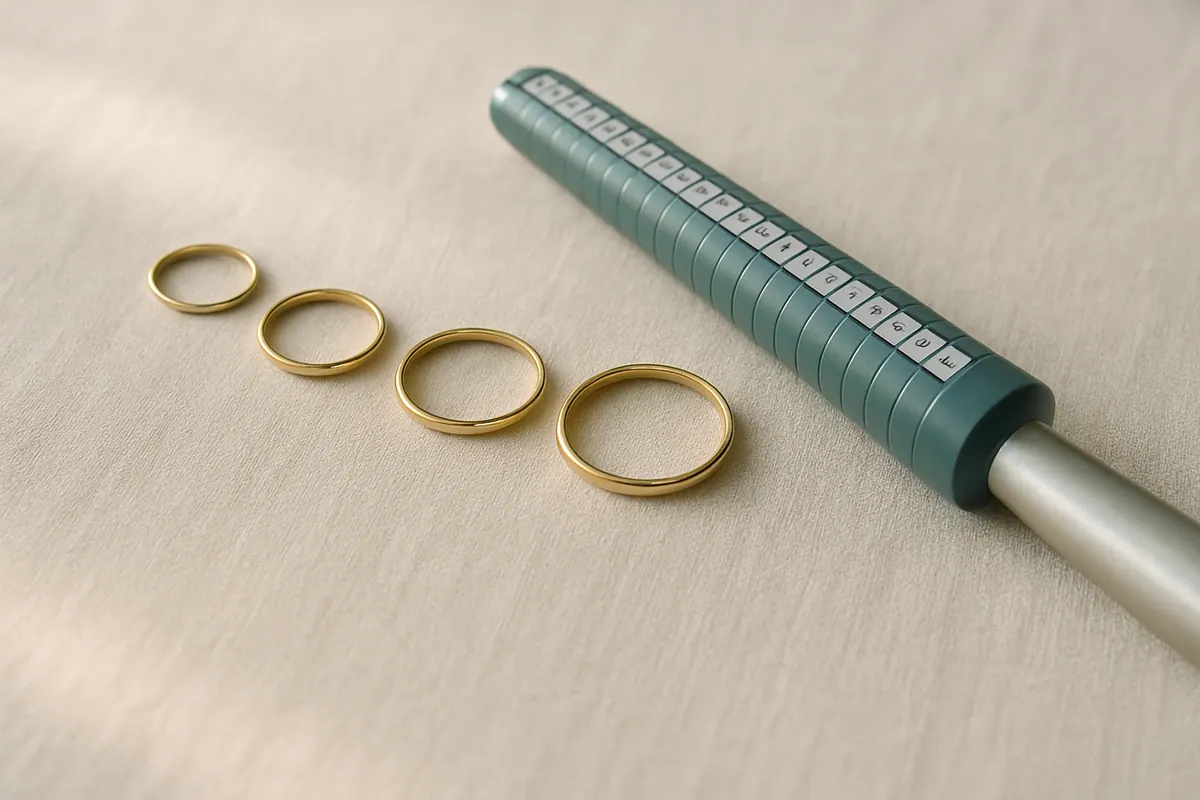
The women's ring size chart below runs from a US 3 to a US 10, which covers almost everyone, with the inside diameter and circumference in millimeters and the UK letter beside each row. Under the chart are the three things that move the number: build, band width, and when you measured.
An average is a fine place to start a guess. It is a poor place to end one. Two women the same height can sit a full size apart, and a full size is the difference between a ring that stays put and a ring that turns stone-down every time you pick up a bag.
What is the average ring size for a woman?
Most women wear a US 5 to 7, and a 6 is the most common single size. Blue Nile puts the usual range at 5 to 7 with size 6 the most popular. Serendipity Diamonds went back through five years of its own orders and found UK size L outsold every other women's size it shipped.
Those two agree more than they look. The UK average for engagement rings falls between L and N, which straddles a US 6, and Serendipity puts the US average a little higher again at 6.5. So if you have nothing at all to go on, a 6 or 6.5 is the guess with the most orders behind it.
Still, that is a guess with a wide spread behind it. Her own ring from ten years ago is a rough guide at best, and a mother's ring is worse. For the other half of the scale, the men's ring size chart covers US 7 to 15 and the wide-band math that goes with it.
Women's ring size chart in millimeters
Ring size is the inside circumference of the band, measured in millimeters, under the international standard ISO 8653. The US scale converts on a straight line: circumference in mm is 36.54 plus 2.55 times the size number, and the diameter is that circumference divided by pi.
| US size | Dia mm | Circ mm | UK |
|---|---|---|---|
| 3 | 14.1 | 44.2 | F |
| 3.5 | 14.5 | 45.5 | G |
| 4 | 14.9 | 46.8 | H |
| 4.5 | 15.3 | 48.0 | I |
| 5 | 15.7 | 49.3 | J 1/2 |
| 5.5 | 16.1 | 50.6 | K 1/2 |
| 6 | 16.5 | 51.9 | L 1/2 |
| 6.5 | 16.9 | 53.1 | M 1/2 |
| 7 | 17.3 | 54.4 | N 1/2 |
| 7.5 | 17.7 | 55.7 | O 1/2 |
| 8 | 18.1 | 57.0 | P 1/2 |
| 8.5 | 18.5 | 58.2 | Q 1/2 |
| 9 | 18.9 | 59.5 | R 1/2 |
| 9.5 | 19.4 | 60.8 | S 1/2 |
| 10 | 19.8 | 62.1 | T 1/2 |
Brilliant Earth publishes the same figures on its own chart: 44.2 mm around at a size 3, 54.4 mm at a 7, 62.1 mm at a 10. If a chart somewhere else reads 58.3 mm for an 8.5 where this one reads 58.2, that is rounding, not a different ring.
Two conversions you can do in your head from that table. A European size is the circumference rounded off, so a US 6 is an EU 52 and a US 7 is an EU 54. And if you need inches, divide the circumference by 25.4: a size 6 is 2.04 inches around, a size 7 is 2.14. The full ring size chart carries every size to a 13 and adds the Japan column.
One warning about the diameter column. That is the width of the hole, not the width of the band, and it is not something you can measure on a finger. Use it only when you are measuring a ring somebody already owns.
Does build change a woman's ring size more than height?
Yes. Finger thickness tracks build and bone, not how tall you are, which is why height charts and ring sizes disagree so often. The clearest number on this comes from a study that was not about jewelry at all: anesthesiologists measuring 300 women to check whether blood pressure finger cuffs would fit them.
Lim and colleagues, writing in BMC Anesthesiology in 2020, measured the middle finger of every patient and split the group by body mass index. The 194 women below the obesity threshold averaged 5.2 cm around the finger. The 106 above it averaged 5.5 cm. That gap is 3 mm of circumference, which on the US ring scale is a little more than one full size.
Read that with two caveats. They measured across the middle of the finger rather than at the base where a ring sits, and every woman in the study was in late pregnancy, when hands hold extra fluid. What carries over is the shape of the finding, not the exact millimeters: weight moves finger circumference by about a size, and it moves it more than height does.
As a starting guess before you measure anything:
- Slim or small hands: often a US 4.5 to 5.5, so 48 to 51 mm around.
- Average build: often a US 6 to 7, so 52 to 54 mm around.
- Larger or taller: often a US 7.5 to 8.5, so 56 to 58 mm around.
- Hands that do heavy or repetitive work often measure larger than they look. Size the hand you have now, not the one you had at 25.
Does band width change a woman's ring size?
Sometimes, but less often than on a man's hand, because women's bands are narrow to begin with. Brilliant Earth's guide puts the most popular women's wedding band widths at 2 mm to 3 mm and engagement rings at 1.5 mm to 2.5 mm. All of those sit under the point where the adjustment kicks in.
The rule itself is plain. A wider band feels tighter than a narrow one at the same size, because it presses on more of the finger and has to travel over the knuckle across a longer stretch. Brilliant Earth's advice for a wider style is to size up by half a size. On women's rings, that mostly matters for a chunky signet, a wide cigar band, or an eternity ring in a 4 mm setting.
Stacking is the case people miss. Three 2 mm bands worn together on one finger behave like a single 6 mm band, so a stack that fits perfectly on the shelf can be tight by the afternoon. If you plan to stack, measure with all of them on, or add a quarter size to the set.
How do I measure my own ring size at home?
Wrap a strip of paper around the base of the finger, mark where it overlaps, then lay the strip flat against a ruler and read it in millimeters. That number is your circumference, and the chart above turns it into a US size. It takes two minutes and needs nothing you do not already have.
The printable ring sizer skips the conversion entirely. It prints a strip to true scale with a calibration bar you check against a ruler first, so you wrap it and read the size straight off the strip. Skip the check and you will get the wrong answer, because browsers shrink pages to fit the paper by default and a 94 percent print turns a real size 6 into a 7. For the string method and the ring-tracing method written out step by step, see how to measure ring size at home.
Three habits fix most bad measurements:
- Measure late in the day when your hands are warm. Blue Nile says the same thing, and it puts measuring with cold fingers on its list of the most common sizing mistakes.
- Measure the knuckle as well as the base. If the knuckle is wider, Blue Nile's advice is to take both readings and choose a size between them.
- Take three readings on different days and use the one that repeats, not the smallest one.
Hands are not a fixed size, so none of this is fussiness. Why ring size changes has the numbers on how far a finger travels between a cold morning and a salty dinner.
How do I find her size without asking?
Borrow a ring she already wears on the correct finger, lay it flat, and measure straight across the inside at its widest point in millimeters. Match that diameter to the chart above. A 16.5 mm hole is a size 6. If you would rather work in circumference, multiply the diameter by 3.14.
The finger matters as much as the ring. A right-hand ring is often a half size off the left, and a ring worn on the middle finger tells you very little about the fourth. How to find their ring size secretly covers the ring-tracing method and what to do when there is nothing to borrow.
How wrong is a guess, in millimeters?
One US size is 2.55 mm of circumference and 0.81 mm of diameter. That sounds like nothing written down. On a finger it is the difference between a ring that stays where you put it and one that spins the stone under your palm, or slips off in cold water.
Guessing is cheap on a costume ring and expensive on a real one. A gold or platinum band goes back to a jeweler and comes out a size or two either way for a modest fee. Tungsten, titanium, and full eternity bands cannot be cut and rejoined at all, so a wrong size on one of those is an exchange rather than a repair. Which rings cannot be resized has the list by metal, and it is worth reading before you order, not after.
Find your size in two minutes
Print a true-scale sizer with a built-in scale check, or convert a millimeter measurement on the page.