Men's ring size chart
Most men wear a US ring size between 8 and 12, and the average sits at a 9 or 10. A size 9 measures 18.9 mm across the inside and 59.5 mm around. A size 10 is 19.8 mm across and 62.1 mm around. Ring size is set by inside circumference under ISO 8653, and each full US size adds about 2.55 mm of circumference, so a half size is only 0.4 mm of diameter.
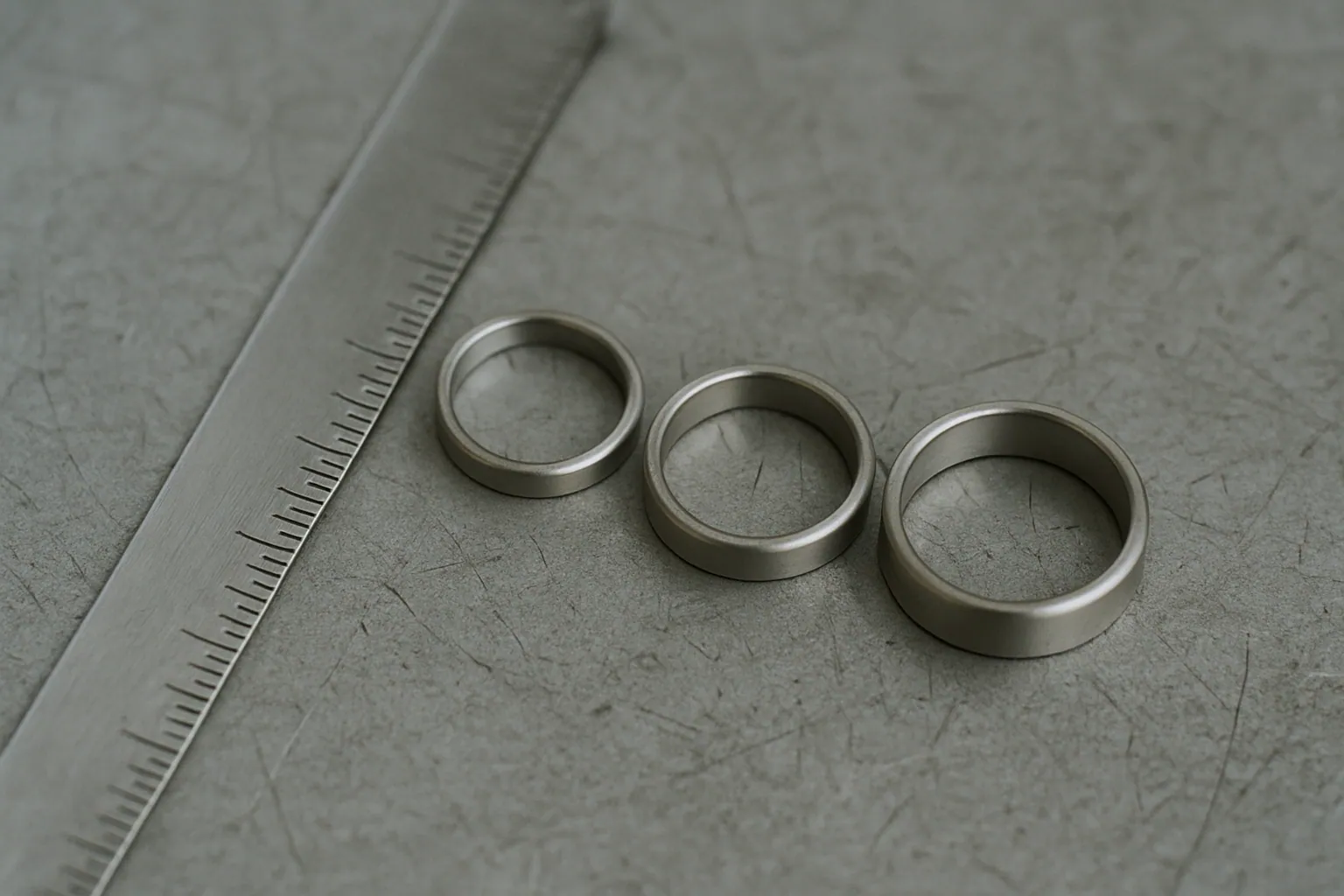
Men's rings run larger and wider than women's, and both of those change the number you order. The chart below gives every US size a man is likely to wear, with the inside diameter and the inside circumference in millimeters. Under it are the two rules that trip people up on a men's band: a wide ring fits tighter than a thin one at the same size, and a comfort fit band fits looser than a standard one.
What is the average men's ring size?
The average men's ring size in the US is a 9 to 10, and most men land somewhere between an 8 and a 12. Brilliant Earth puts the common men's range at 9 to 10. Just Men's Rings, which sells nothing else, reports 8 to 12 as the bulk of what it ships. Hand size varies far more than that range suggests, so treat it as a starting guess.
Build matters more than height. A tall man with slim fingers can wear an 8.5, and a shorter man who works with his hands can wear a 12. If you are buying for someone else and have nothing to measure, average ring size for women and men covers how far a guess usually lands from the real number.
Men's ring size chart in millimeters
Ring size is defined by the inside circumference of the band, measured in millimeters, under the international standard ISO 8653. The US scale converts with a straight line: circumference in mm is 36.54 plus 2.55 times the size number. Diameter is that circumference divided by pi. Every full size adds about 0.81 mm of diameter, and a half size adds about 0.4 mm.
| US size | Dia mm | Circ mm |
|---|---|---|
| 7 | 17.3 | 54.4 |
| 7.5 | 17.7 | 55.7 |
| 8 | 18.1 | 57.0 |
| 8.5 | 18.5 | 58.2 |
| 9 | 18.9 | 59.5 |
| 9.5 | 19.4 | 60.8 |
| 10 | 19.8 | 62.1 |
| 10.5 | 20.2 | 63.3 |
| 11 | 20.6 | 64.6 |
| 11.5 | 21.0 | 65.9 |
| 12 | 21.4 | 67.2 |
| 12.5 | 21.8 | 68.5 |
| 13 | 22.2 | 69.7 |
Above a 13 the same math keeps going. A US 14 is 23.0 mm across and 72.3 mm around, and a US 15 is 23.8 mm across and 74.8 mm around. Not every design is stocked that large, so check the size range before you fall for a ring.
One note on precision. Jewelers round these figures differently, so a chart somewhere else may read 58.3 mm for a size 8.5 where this one reads 58.2 mm. That is rounding, not a different size. A tenth of a millimeter is a quarter of a half size, well inside the error of any home measurement. The full ring size chart runs from a size 3 to a 13 and adds the UK, EU, and Japan equivalents.
How do I measure my ring size for a men's ring?
Measure the inside of a ring he already wears on that finger, or wrap the finger and read the millimeters. Lay a ring flat and measure straight across the inside at its widest point, then find that diameter in the chart above. To measure the finger, wrap a strip of paper at the base, mark the overlap, and read the length against a ruler in millimeters.
The paper strip has one catch on a man's hand: big knuckles. Slide the strip over the knuckle before you settle on a number, because a ring sized to the base of the finger will not go on if the knuckle is a size larger. Measure both, and order the larger of the two readings.
If you have a printer, the printable ring sizer skips the conversion. It prints a strip to true scale with a calibration bar you check against a ruler first, so you wrap it and read the US size straight off. For the string method and the ring-tracing method written out step by step, see how to measure ring size at home.
Does band width change your ring size?
Yes. A wide band fits tighter than a thin one at the same nominal size, because it presses against more of the finger and has to clear the knuckle over a longer stretch. Brilliant Earth advises sizing up about half a size for bands over 4 mm. Men's wedding bands usually run 5 mm to 8 mm, so the adjustment applies to most of them.
A rough guide once you have your base size from a thin sizer:
- Under 4 mm: order your measured size.
- 4 mm to 6 mm: add a quarter size.
- 6 mm to 8 mm: add a half size.
- Over 8 mm: add a half size, and try a real 8 mm sizer first if a jeweler has one.
This is the single most common reason a men's band arrives and will not go past the knuckle. If you were measured for an engagement ring with a 2 mm shank and you are now ordering an 8 mm band, that measurement is not the size to order.
How does comfort fit change the size?
A comfort fit band is domed on the inside, so only the middle of the band touches your finger. That makes it slide on more easily and feel looser than a standard flat band of the same size. Larson Jewelers and other men's-band retailers recommend ordering a comfort fit half a size smaller than your measured standard fit size.
The two adjustments work against each other, which is where people get lost. A 6 mm comfort fit band is a half size up for width and a half size down for the dome, so it lands back at your measured size. A 6 mm standard fit band in the same metal needs the half size up. Read the product page: most men's bands sold today are comfort fit, but plenty are not.
Before you order
Check whether the ring can be resized at all. A gold or platinum band comes back from a jeweler a size or two either way for a modest fee. Tungsten carbide, titanium, and ceramic cannot be cut and rejoined, so a wrong size means an exchange, not an alteration. Those metals are common in men's bands, which raises the cost of guessing. Which rings cannot be resized has the list by metal.
Measure warm and late. Hands read small when they are cold or first thing in the morning, and a man who has been outside in November can measure a full half size under his real size. Take two or three readings on different days and go with the one that repeats. Then confirm the number against the ring size chart before you check out.
Find your size in two minutes
Print a true-scale sizer with a built-in scale check, or convert a millimeter measurement on the page.