Ring size conversion by country
Ring size conversion works through one number every country shares: the inside circumference in millimeters. The ISO 8653:2016 standard uses that number as the size, so an EU 54 is 54 mm around. The US adds 2.55 mm per size, the UK adds 1.25 mm per letter, and Japan adds about 1.05 mm per number. A US 7 is 54.4 mm, which is a UK N 1/2 and an EU 54.
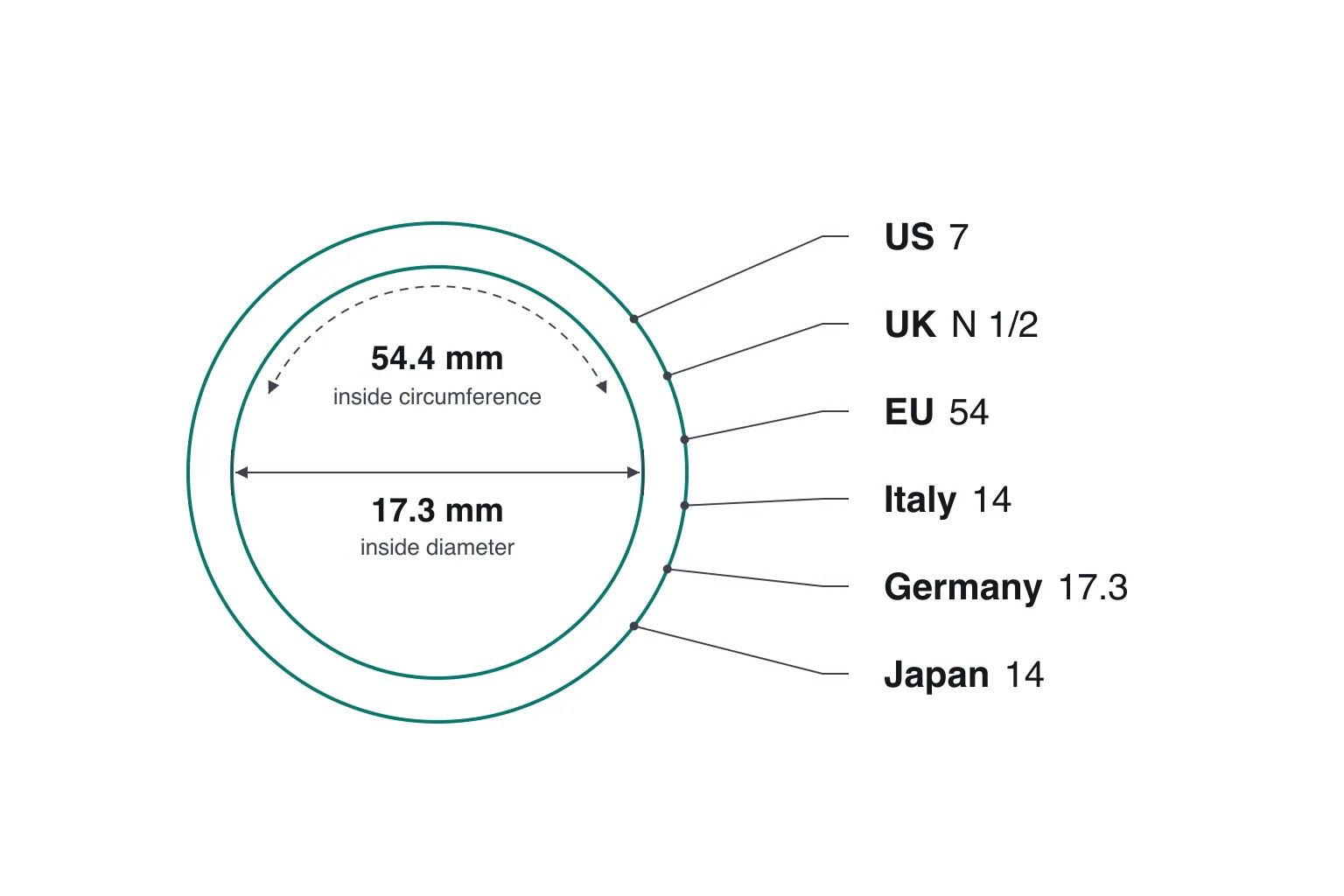
Every ring size system in the world is measuring the same thing: the circle on the inside of the band. The labels differ. The US counts in numbers, the UK in letters, most of Europe in millimeters, Germany in diameter, and Japan in a numbered scale with steps a third the size of the American ones. Once you turn any of them into millimeters, you can read across to all the others.
So a US 7 is not a UK 7 or an EU 7. It's 54.4 mm around the inside, and that 54.4 is what you carry from one chart to the next.
Why are ring sizes different in each country?
Ring sizes differ because each region built its own scale before any international standard existed. The US picked numbers with a fixed diameter step, Britain picked letters, and continental Europe used the plain circumference in millimeters. None is more accurate. They are different names for the same physical opening, so conversion is arithmetic, not guesswork.
Britain wrote its scale down as BS 1283 in 1945 and replaced it with BS 6820 in 1987. The international standard, ISO 8653, took the simplest route and made the size equal to the inside circumference. Its current edition is from 2016, and it's the scale Pandora uses and the one you'll shop in across France, Austria, and the Nordic countries.
What ring size system does each country use?
There are six systems worth knowing. Nearly every shop you'll order from uses one of them:
- US, Canada, and Mexico use numbers from about 3 to 13 in half and quarter steps. Each whole size adds 2.55 mm to the inside circumference, which is 0.81 mm of diameter.
- The UK, Ireland, Australia, New Zealand, and South Africa use letters. Size C is 40 mm around, and each letter adds 1.25 mm, so a half letter is 0.625 mm.
- France, Belgium, Austria, and the Nordic countries use ISO 8653. The size is the inside circumference in millimeters, so a 52 is 52 mm around.
- Italy, Spain, and Switzerland take the circumference and subtract 40. A 54 mm ring is a size 14 there.
- Germany and the Netherlands use the inside diameter in millimeters, often stamped right inside the band. A German 17 is a hole 17 mm across.
- Japan numbers its sizes from 1, which is a 13 mm hole, and adds a third of a millimeter of diameter per size. China often reuses the Japanese numbers. India has its own numbered scale with no clean formula, so ask an Indian seller for millimeters.
A quarter US size (0.64 mm of circumference) and a half UK letter (0.625 mm) are almost the same step. That's why a US quarter size nearly always lands on a UK half letter.
Ring size conversion chart
Every row below starts from the US size and the ISO circumference in millimeters (the mm column), then applies each country's rule. The circumference follows the formula this site uses on every page: 36.54 mm plus 2.55 mm per US size.
| US | mm | UK | EU | IT/CH | DE | JP |
|---|---|---|---|---|---|---|
| 4 | 46.8 | H | 47 | 7 | 14.9 | 7 |
| 5 | 49.3 | J 1/2 | 49 | 9 | 15.7 | 9 |
| 6 | 51.9 | L 1/2 | 52 | 12 | 16.5 | 11-12 |
| 7 | 54.4 | N 1/2 | 54 | 14 | 17.3 | 14 |
| 8 | 57.0 | P 1/2 | 57 | 17 | 18.1 | 16 |
| 9 | 59.5 | R 1/2 | 60 | 20 | 18.9 | 19 |
| 10 | 62.1 | T 1/2 | 62 | 22 | 19.8 | 21 |
| 11 | 64.6 | V 1/2 | 65 | 25 | 20.6 | 24 |
| 12 | 67.2 | Y | 67 | 27 | 21.4 | 26 |
The Japan (JP) column is computed from the Japanese scale's own rule (a 13 mm hole at size 1, plus a third of a millimeter per size), so it can sit one number higher than older printed tables. A Japanese 14 is 17.33 mm across, and a US 7 is 17.32 mm. Japanese jewelers such as Mokumeganeya list a 14 at 54.5 mm around, which matches.
The full ring size chart has every half size from 3 to 13 with diameter and circumference to two decimals.
How do I convert ring sizes between countries?
Turn the size you know into inside circumference in millimeters, then turn that millimeter value into the size you need. Every system has a one-line rule, listed below. You never convert UK straight to Japan or Italy straight to US. You always go through millimeters, so rounding happens once instead of twice.
The rules, from size to millimeters of circumference:
- US: 36.54 plus 2.55 times the size. A US 6.5 is 53.1 mm.
- UK: count letters from C (C is 40 mm) and add 1.25 mm per letter. M is ten letters past C, so 52.5 mm.
- EU: the size is the millimeters. An EU 56 is 56 mm.
- Italy, Spain, Switzerland: add 40. An Italian 12 is 52 mm.
- Germany: multiply the diameter by 3.1416. A German 17 is 53.4 mm.
- Japan: the diameter is 13 plus a third of (size minus 1), then multiply by 3.1416. A Japanese 11 is 16.33 mm across and 51.3 mm around.
To go the other way, run the rule backward. For US, subtract 36.54 and divide by 2.55. Round US results to the nearest quarter, UK to the nearest half letter, and German to the nearest tenth of a millimeter.
Worked example: a UK M in every other system
A UK M is 52.5 mm around. In US sizes that's 52.5 minus 36.54, which is 15.96, divided by 2.55: a US 6.25. The EU size is 52.5, so a European shop will sell it as a 52 or a 53. Italy calls it a 12.5, Germany calls it 16.7 (52.5 divided by 3.1416), and Japan calls it a 12.
If the EU shop only stocks whole sizes, pick the 53. A ring half a millimeter too big you'll barely notice. Half a millimeter too small, you notice at the knuckle.
Worked example: a German 18 bought in the US
A German 18 has an 18 mm hole, so 56.5 mm around. That comes out to a US 7.84, which you'd order as a 7.75. In the UK it's a P, and in Japan it's exactly a 16. If a US shop only sells half sizes, you're choosing between a 7.5 (55.7 mm) and an 8 (57.0 mm), and the 8 is closer.
Why do two charts give different answers for the same size?
Charts disagree because of rounding and because the steps don't line up. A US size is 2.55 mm, a UK letter 1.25 mm, and a Japanese size about 1.05 mm, so most sizes fall between two labels on the other scale. One chart rounds down and another rounds up. Neither is wrong, but the millimeters settle it.
The US 7 row shows this well. The math puts it at 54.4 mm, which sits 0.03 mm above UK N 1/2, but plenty of charts print a plain N, a full half letter smaller. Japan is the same story: a US 7 lands at 13.96 on the Japanese scale, so some tables say 13 and others 14.
Two things fix it. First, when a chart gives a size, look for its millimeter column and trust that over the label. Second, if you land between two sizes, go up for a wide band. A 6 mm band sits tighter than a 2 mm band at the same size, and the men's ring size chart has the numbers on how much.
What if a shop only lists one system?
Ask for the inside circumference or diameter in millimeters. A jeweler who ships abroad should be able to give it, and a ring stamped in German sizing already shows it. Then measure your own finger in millimeters and compare. A ring you already own works too: measure straight across the inside and multiply by 3.1416.
A few brands you'll run into use a system that looks local but isn't. Pandora prints ISO sizes (the millimeters), so a Pandora 54 is a US 7, and the Pandora ring size guide has the full list. Tiffany lists standard US sizes. Oura uses its own sizing kit, and its numbers don't match any jewelry scale.
To get your number in millimeters, the printable ring sizer prints to true scale with a bank-card outline you check first. Browsers shrink pages to fit the paper by default, and a 94 percent print can make a US 6 read as a 7, so the check matters. No printer? How to measure ring size at home covers the paper-strip method with a ruler.
Measure late in the day when your hands are warm, and measure twice. The time of day moves a finger more than the gap between two neighboring UK letters, and why ring size changes has the details.
Find your size in two minutes
Print a true-scale sizer with a built-in scale check, or convert a millimeter measurement on the page.