Oura ring size chart
Oura ring sizes use US-style numbers, but they are not US jewelry sizes. Measured inner diameters put an Oura Ring 4 size 8 at 17.95 mm, which is close to a US 7.75, and the older Gen3 ran about a size and a half tighter than its number because its sensors bulged into the opening. Ring 4 covers sizes 4 to 15, Ring 5 covers 6 to 13, and Oura makes whole sizes only. The free sizing kit is still the step that decides it.
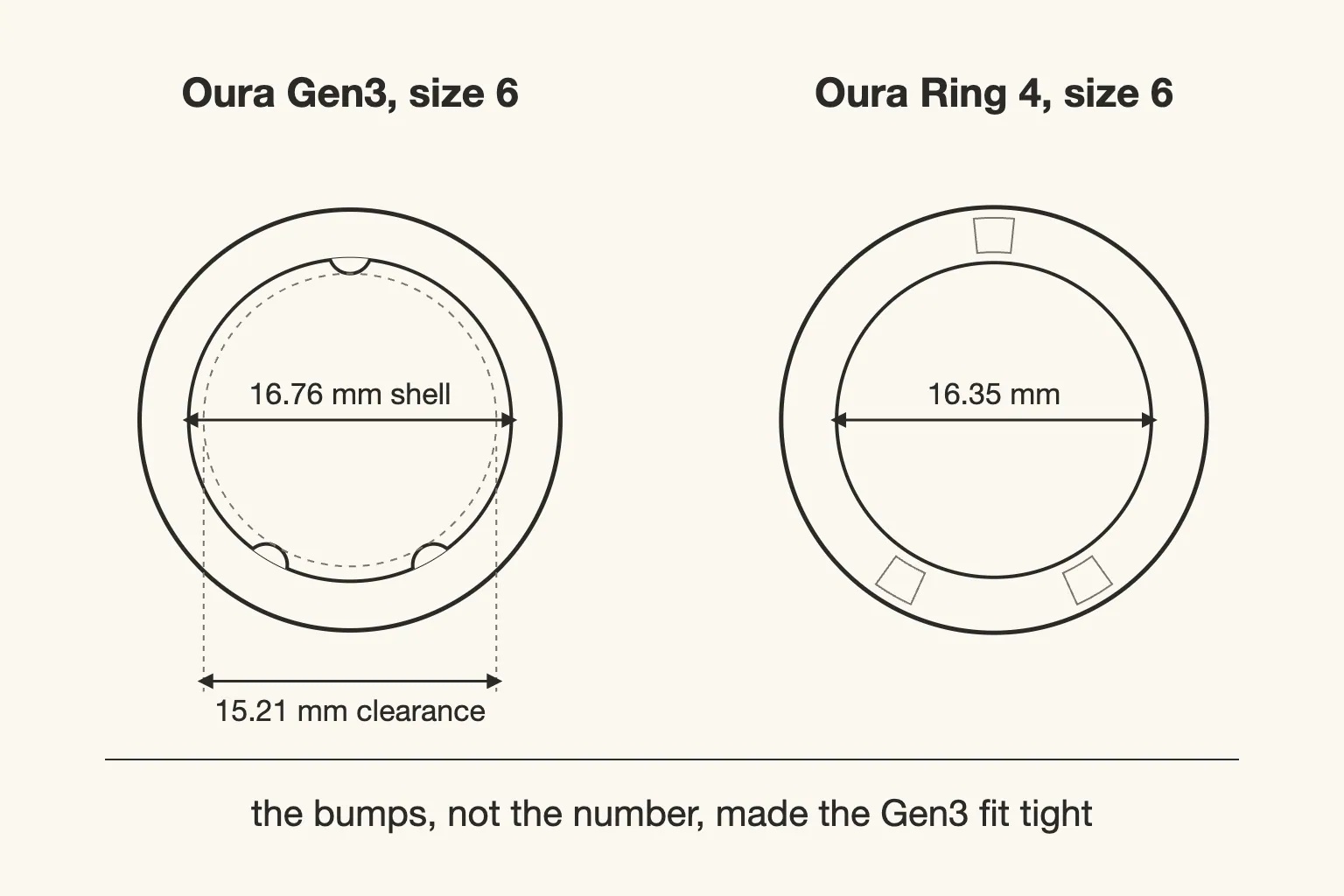
Oura has redrawn the inside of the ring in every generation, and the inside is the part that sets your size. That is why the company asks you to test with a kit even if you already wear one of its rings. The charts below give you the millimeters, so you can work out roughly where you land before the plastic sizers arrive.
Are Oura ring sizes the same as US ring sizes?
No. Oura sells whole sizes only, no 6.5 or 7.5, and its support pages say the sizes differ slightly from standard US ring sizes. On a Ring 4 that difference is about a quarter of a size. On the Gen3 it was closer to a size and a half, which caught a lot of people out.
A jewelry size is defined by the inside circumference of the band under ISO 8653, and the US scale is a straight line: circumference in mm is 36.54 plus 2.55 per size. A US 8 measures 56.97 mm around the inside and 18.13 mm across it. A smart ring has no reason to sit on that line. Oura's shell carries a battery, two triple LEDs, photodetectors, and a temperature sensor, and the inner profile has been redrawn twice to make room for them.
So treat the number on the box as a label rather than a measurement. What fits your finger is the inner surface, and that is the thing the sizing kit tests. Our full ring size chart covers the jewelry scale if you need the standard numbers to compare against.
Oura Ring 4 size chart in mm
Oura does not publish inner diameters for any of its rings. The figures below are measured ones, from wearablexp's comparison of Oura sizers against standard jewelry sizes, and the US column is worked from the ISO formula this site uses on every page. Read them as good to about a tenth of a millimeter, not as a spec sheet.
| Oura | Dia mm | Circ mm | US size |
|---|---|---|---|
| 4 | 14.70 | 46.2 | 3.8 |
| 5 | 15.52 | 48.8 | 4.8 |
| 6 | 16.35 | 51.4 | 5.8 |
| 7 | 17.13 | 53.8 | 6.8 |
| 8 | 17.95 | 56.4 | 7.8 |
| 9 | 18.72 | 58.8 | 8.7 |
| 10 | 19.55 | 61.4 | 9.7 |
| 11 | 20.35 | 63.9 | 10.7 |
| 12 | 21.25 | 66.8 | 11.8 |
| 13 | 22.05 | 69.3 | 12.8 |
| 14 | 22.73 | 71.4 | 13.7 |
| 15 | 23.70 | 74.5 | 14.9 |
Read down the last column. Every Ring 4 size lands a fraction under its own number: an Oura 8 sits near a US 7.8, an Oura 10 near a US 9.7. A quarter of a size is 0.2 mm of diameter, which no home measurement will resolve, so use this to sanity-check a kit result rather than to skip the kit.
The Ring 4 is 7.90 mm wide and 2.88 mm thick in titanium, and it weighs 3.3 g to 5.2 g depending on the size. The ceramic version is thicker at 3.51 mm and heavier at 5.1 g to 8.1 g. Its interior is fully round with the sensors recessed into the wall, and that change is what pulled Ring 4 sizes back toward the jewelry scale.
Why does an Oura Ring feel tighter than your other rings?
Because the sensors used to stick out. On the Gen3, three sensor bumps protruded into the opening, so the clearance your finger had to pass through was smaller than the ring's inner diameter. A Gen3 size 6 has a 16.76 mm shell but only 15.21 mm of usable opening, and 15.21 mm is a US 4.4.
| Gen3 | Shell mm | Clear mm | US size |
|---|---|---|---|
| 6 | 16.76 | 15.21 | 4.4 |
| 7 | 17.60 | 15.97 | 5.3 |
| 8 | 18.43 | 16.81 | 6.4 |
| 9 | 19.25 | 17.63 | 7.4 |
| 10 | 20.02 | 18.41 | 8.3 |
| 11 | 20.81 | 19.24 | 9.4 |
| 12 | 21.64 | 20.05 | 10.4 |
| 13 | 22.48 | 20.90 | 11.4 |
The shell column tracks the US scale within a third of a size. The clear column, the one your knuckle has to pass, sits a size and a half lower. A Gen3 buyer who ordered by their jewelry size and skipped the kit ordered a ring far too small, and that is where the reputation for tight Oura rings comes from. If you are replacing a Gen3, your old number is not your new number.
Some of that snugness is deliberate. The sensors read light through the skin, so the ring has to keep contact at the base of the finger. Oura's own fit test is the fist: make one, and if you can see a gap between the ring and the top of your finger, go down a size. A ring that spins is a ring that logs night heart rate you cannot trust.
What sizes does the Oura Ring 5 come in?
Sizes 6 to 13, whole sizes only. Oura opened preorders on 28 May 2026 and started shipping on 4 June 2026, at $399 for silver or black and $499 for the gold, stealth, brushed silver, and deep rose finishes. The Ring 5 is 6.09 mm wide and 2.28 mm thick, against 7.90 mm and 2.88 mm on the Ring 4, and it weighs 2 g to 2.69 g.
That narrower band comes from a rebuild of the whole interior around low-profile sensor domes and a new battery, roughly 40 percent smaller overall. Oura states the Ring 5 sizing differs from the Ring 4 and tells you to use the matching kit. Take that as a warning rather than a formality. Note also that the range has shrunk at both ends: if you wear a 4, a 5, a 14, or a 15, the Ring 4 is the only Oura that will fit you.
Inner diameters for the Ring 5 are not public. Oura has not released them, and no independent measurement of the new sizers has surfaced yet, so there is no honest millimeter chart to give you for this generation. Measure your finger, compare it against the Ring 4 column above, and treat the result as a starting point.
How do I find my Oura size before the kit arrives?
Measure the inside circumference of the finger in millimeters and read it off the chart above. Wrap a paper strip around the base of your index finger, mark where it overlaps, then lay the strip flat against a ruler. A 56 mm reading falls between an Oura Ring 4 size 7 and size 8, and lands nearer the 8.
Our printable ring sizer prints a strip to true scale with a calibration bar, and the converter on that page turns a millimeter reading into a size. Check the bar with a ruler before you trust the strip. Browsers shrink pages to fit the paper by default, and a page printed at 94 percent will read a true 54 mm finger as 57.
This gets you to the right pair of sizes, not to the answer. Use it to catch a bad kit result, to check whether you fall outside the 6 to 13 range Ring 5 offers, or to see how far apart your index and ring fingers measure. Five ways to find your ring size covers measuring a ring you already own, which works here as long as the ring fits the finger you plan to wear the Oura on.
Wearing the sizer, and which finger to use
Wear it for a full day and sleep in it. That is Oura's instruction, and it exists because a finger is not the same size at 7 am and 7 pm. Try the sizers on both hands and on more than one finger before you commit, since a comfortable fit on the left index can be a different number on the right.
Oura recommends the index finger for accuracy, with the middle or ring finger as workable alternatives. It also says to avoid a finger whose knuckle is much wider than the base. That is sound for any ring and doubly so here, because a ring sized to clear a big knuckle will spin at the base, and a spinning ring loses the skin contact the sensors need.
Fingers move about a quarter of a size across a day and up to half a size across the seasons, which is why the overnight test matters more for a smart ring than for a wedding band. Why ring size changes has the numbers on heat, salt, and time of day.
Does the width of the band change your Oura size?
Not on top of a kit reading. A 7.90 mm Ring 4 counts as a wide band by jewelry standards, and the usual rule adds half a size for anything between 6 mm and 8 mm. But Oura says the sizers match the ring in width and circumference, so that adjustment is already inside the number the kit hands you. Applying it twice is how people end up with a ring that slides.
The rule still applies if you are working from a paper strip instead. Wrap 2 mm of paper around a finger and you have sized a 2 mm band. An 8 mm titanium ring has to clear the knuckle across four times that stretch of finger, so it will feel tighter at the same nominal size. Add a quarter to a half size to a strip reading before comparing it to the Ring 4 chart. The men's ring size chart has the width table that rule comes from.
Ring 5's 6.09 mm band sits at the bottom of that same bracket rather than the top. One more reason its sizes will not map cleanly onto Ring 4's.
What if you are between two Oura sizes?
Go down, which is the reverse of the advice for a wedding band. Oura tells you to take the smaller size when you are stuck, for two reasons: the sensors need contact with the skin, and the finished titanium ring slides on more smoothly than a plastic sizer does.
A jeweler would tell you to size up, because a loose ring is still wearable while a tight one may never pass the knuckle. Both answers are right for their own object. A gold band that spins is an annoyance. An Oura that spins produces sleep data you cannot act on. With no half sizes anywhere in the range, one of the two candidates is going to be a compromise, so pick the failure you mind less.
If both sizers feel wrong in different ways, wear each one for a night and compare in the morning. Order the one you noticed less. And if the ring turns up and it is clearly the wrong size, Oura's Member Care handles size problems, so raise it early instead of spending a month talking yourself into it.
Find your size in two minutes
Print a true-scale sizer with a built-in scale check, or convert a millimeter measurement on the page.